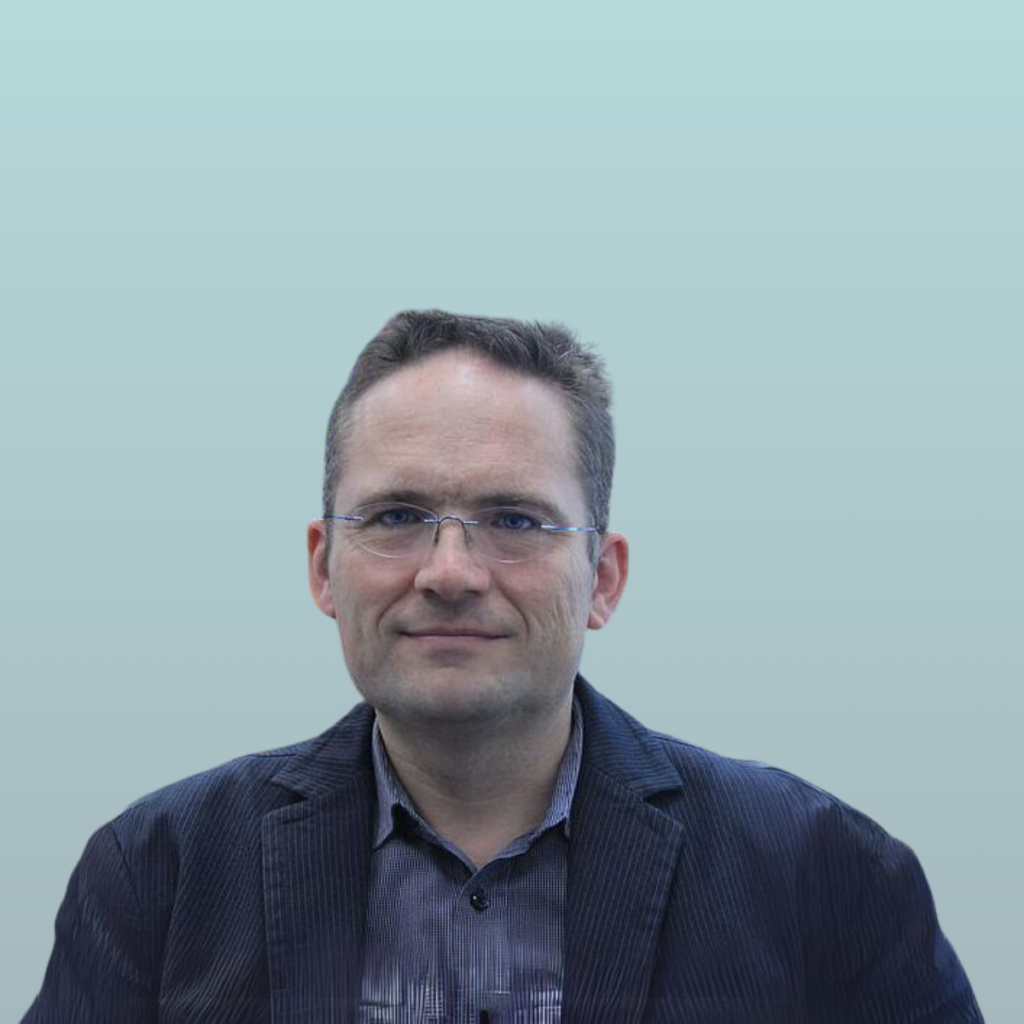
Sonia Ramudo (DEC Manager at CEL) asks: Can you explain what is egeniouss all about?
Markus Gerke (Head of Institute of Geodesy and Photogrammetry at TUBS) answers: In egeniouss we are working on visual localisation, that is, we use images, taken from a smartphone or a UAV, which means “Unmanned Aerial Vehicle” to aid the determination of the position and attitude of that device in a global coordinate frame. This is to support in cases, where Global Navigation Satellite Systems, such as GPS or Galileo, do not perform well, for instance in dense urban areas. Though egeniouss also features a deep sensor integration on the device, the image-based localisation is a key component. Base for that job is a so-called geospatial aerial mesh: a 3D representation of the built environment derived from professional very high resolution airborne images, but also simplified 3D city models, similar to CAD models are used.
Sonia Ramudo ((DEC Manager at CEL) asks: What is the purpose of a benchmark?
Markus Gerke (Head of Institute of Geodesy and Photogrammetry at TUBS) answers: Benchmarks are common in many scientific domains to foster research in a specific fields. It enables researchers to compare the performance of their solution to those of others. Results are usually published and ranked.
Sonia Ramudo(DEC Manager at CEL) asks: What is the egeniouss benchmark?
Markus Gerke (Head of Institute of Geodesy and Photogrammetry at TUBS) answers: egeniouss bench provides very high detailed reference data of the mentioned type, but also it comes with images taken from a smartphone in the target area, we call them query images. We computed the pose of those images with very high accuracy, but this information is not entirely available to the participants of the benchmark challenge. The task is now to use state-of-the-art visual localisation methods to derive that information and submit. We will compare the submitted poses with the ground truth and compute accuracy measures, which will be published on a leader board. Compared to other benchmarks addressing visual localisation, Egeniouss bench comes with high accuracy for the reference poses of the query images, and 3D city models are also not very common so far
Sonia Ramudo (DEC Manager at CEL) asks: With the publication, you launched a call for competition to challenge the benchmark. What do you expect from it, as a scientist but also for egeniouss in general?
Markus Gerke (Head of Institute of Geodesy and Photogrammetry at TUBS) answers: Since we have access to very high-accuracy reference data for the query images, comparing state-of-the-art methods enables an in-depth performance analysis. For egeniouss we can understand in general the accuracy and reliability levels which are possible with visual localisation, and also can view our own solution in relation to others.
Join the challenge and try the new egeniouss benchmark to see how your visual localisation approach ranks -> egenioussBench